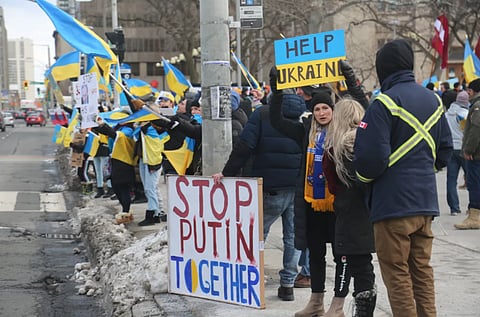


A significant number of Ukrainian war refugees in Canada are likely to remain permanently, Immigration Minister Marc Miller said.
Blacklock's Reporter said despite Canada’s “limited capacity” and only a third of the 962,612 refugees approved to enter actually arriving, Miller emphasized the government’s commitment to their safety.
“I am not sending them back to Ukraine as long as the war continues,” said Miller. “We renew work permits, permits to stay, so there is no fear there.”
Current immigration department data indicates that 298,128 Ukrainian refugees are living in Canada, supported by extensive federal assistance programs.
“We currently have well over 300,000 Ukrainians that we’re housing temporarily as the war goes on,” said Miller.
“There is limited capacity. There are a lot of people who want to stay, that’s for sure.”
While Miller acknowledged that many refugees have integrated into Canadian life, including starting families and marrying Canadians, he stopped short of offering blanket permanent residency.
“I am not ready to grant permanent residency completely to all 300,000 who are here,” he said.
“Obviously with the relations we have with Ukraine, that I think would send a defeatist message regarding the war. But it is certain there are people who become Canadians. You have to show a certain humanity. They can apply for permanent residency like everyone else.”
The Ukrainian refugee program has cost over $1 billion, including $753.4 million under the Canada-Ukraine Transitional Assistance Initiative.
Refugees arriving in Canada have received tax-free grants of $3,000 per adult and $1,500 per minor child, free flights, two weeks of accommodation, free language training, work permits, and various other services tailored to specific groups, such as women, seniors, and LGBTQ individuals.
Meanwhile, Canadians’ support for continued involvement in the conflict appears mixed.
Privy Council research noted that some expressed concerns about the financial burden, with a few questioning how long Canada could feasibly sustain its role.
“Several respondents expressed concerns regarding the financial cost of this ongoing support and whether these funds should instead be used to help Canadians in Canada who were currently struggling to make ends meet financially,” said the report.
Despite this ambivalence, Miller affirmed that Canada will not abandon its humanitarian commitments.
“There are geostrategic considerations obviously with the war still raging in Ukraine,” he said, emphasizing that the safety and well-being of refugees remain a priority.
